MES: Selection and Implementation Manage production in real time
At Citwell, we lead the MES (Manufacturing Execution System) transformation to unlock performance, traceability and real-time operational control. We support projects from strategy through to deployment: requirements, solution selection, processes and governance.
Our strength lies in experts with both industrial and digital expertise, aligning shop-floor objectives with technology’s full potential.
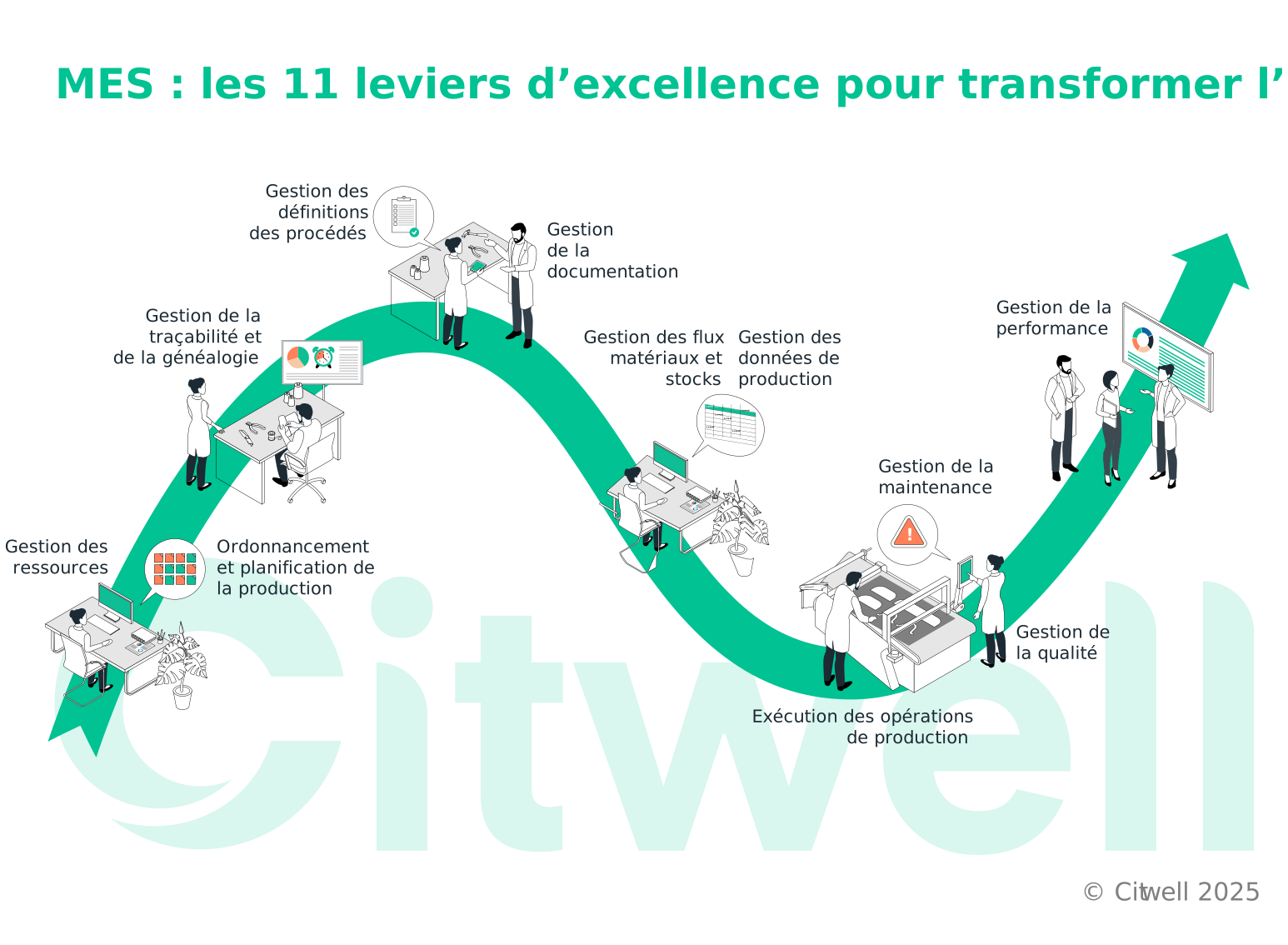
Our convictions
Create value
MES must deliver measurable financial gains by reducing scrap, downtime and manual interventions: lower costs, higher OEE and increased production volumes.
Provide real-time visibility
Real-time transparency across production operations is a key driver. It enables more reliable decision-making, a shared understanding of data across stakeholders, and accurate performance management in a complex industrial environment.
Standardise processes
Standardizing processes and automating data collection help ensure reliable information, reduce errors, and create a solid foundation for continuous improvement and effective performance management.
Optimise resource utilisation
Effective resource management relies on accurate measurement. A MES should enable the continuous optimization of resource utilization (machines, labor, and materials), while reducing waste, excess inventory, and stockouts, and ultimately improving overall performance.
Ensure quality, traceability and regulatory compliance
By collecting data, a MES ensures quality, traceability, and regulatory compliance through systematic batch recording, quality KPI monitoring, real-time alerts, and end-to-end production traceability.
Our solutions and expertise
Upfront assessment and scoping
-
Identification of priority use cases, such as OEE monitoring, quality tracking, traceability, non-conformance management and line-performance management
-
Assessment of site-level digital maturity and definition of an MES roadmap tailored to the industrial context
-
Analysis of the expected ROI for each use case, including gains in productivity, quality, maintenance and costs
MES solution selection
-
Formalization of current and future requirements
-
Preparation of functional and technical specifications
-
Pre-selection of solutions based on our expertise
-
Solution benchmarking
-
Facilitation of solution selection workshops in collaboration with business teams and IT (IS) departments
Target-solution design
- Detailed description of target processes to be digitized (BPMN 2.0)
- Modeling of information flows between ERP, MES, supervisory systems, and IoT
- Definition of multi-site standards for global deployments
Deployment project management
-
Project management or PMO for single-site or multi-site deployments
-
Coordination of software vendors, system integrators, business teams, IT teams, and industrial operations
-
Change management (training, support, and communication)
Post-deployment support
- Performance indicator monitoring
- Functional or technical adjustments (enhancements, fixes)
- Alignment with other transformation initiatives (maintenance, supply chain, quality, Lean, etc.)


A project? Contact us
Partner
Mathieu Naudin is a Partner at Citwell. With ten years of experience in the aerospace industry, he moved into consulting twenty years ago. He specializes in operational performance and cost management, with expertise spanning industrial design, performance management processes, management control, customer-supplier relationships, and interim management.
His objective is to ensure that solutions are effectively implemented, delivering a tangible impact on financial performance.
Among our references

Management of a project to digitise the production batch record.

Multi-site MES project: maturity assessment, software-vendor selection process management and deployment planning.

Selection and implementation of an MES solution.

Bouyer Leroux
Digitising industrial performance and quality
Our intervention
-
Strengthening the continuous-improvement approach, evolving the quality culture and managing performance through paperless processes and digitalisation. The project also incorporates CO2-emissions quotas to improve energy performance across the various plants.
-
Addressing several challenges:
-
Measuring industrial, quality and energy performance across sites, where processes require alignment.
-
Implementing digital tools at workstations to eliminate paper data-collection sheets and monitor performance and quality in real time.
-
Collecting data to improve the management of quality, downtime and traceability, including associated indicators and action plans.
Results
- Analysis of process maturity and scoping of the potential contribution of an MES-type solution.
- Recommendations for current processes, including performance-management routines and data usage, and definition of the necessary functionalities.
- Harmonisation of practices and alignment of functional requirements across business teams, support functions and sites.
- Pre-selection of solutions capable of meeting the requirements.
- Project budget estimates for the identified MES solutions.
- Preparation of specifications and management of the MES software-vendor selection process.
- Recommendation and deployment roadmap.


Aptar
Optimising process control through MES and paperless operations
Our intervention
-
Digitisation of an entirely paper-based batch record that circulated between several departments.
-
Processes no longer aligned with technological and societal developments.
-
Potential errors at various stages of manufacturing, inspection and release, requiring multiple control and re-checking steps to ensure full compliance and zero defects.
-
Frequent waiting times and rework flows caused by a range of issues.
Results
-
Elimination of paper in favour of fully digital operations.
-
Introduction of prescriptive processes that prevent errors in sampling, operations, batch-record compilation and batch-record processing.
-
Harmonisation and optimisation of business processes, reducing batch-record processing and batch-release lead times.
-
Greater control and traceability at every stage.
-
Improved indirect and direct labour productivity.
-
Modernised practices aligned with the expectations of both customers and employees.