AI Control Tower for Manufacturing and Supply Chain
The AI Control Tower for Manufacturing and Supply Chain is designed to give organizations a single, reliable source of truth across their end‑to‑end operations. It goes beyond traditional dashboards by combining harmonized KPIs, real‑time data orchestration, and AI‑driven insights into one unified decision‑making layer.
By standardizing performance measurement while remaining flexible to business‑specific needs, the Control Tower enables teams to detect issues earlier, understand root causes faster, and simulate the impact of decisions before acting. Whether facing volatility in demand, supplier disruptions, or increasing operational complexity, the platform empowers supply chain leaders to move from reactive monitoring to proactive, data‑driven control.
Your stakes
In an environment marked by volatility, complexity, and growing performance pressure, supply chain leaders must ensure alignment, trust, and speed in decision‑making. The stakes lie in establishing a shared performance language, adapting rapidly to changing business needs, and turning data into actionable insight without compromising reliability, governance, or security.
Are your teams truly aligned on performance?
- Do all stakeholders from procurement to manufacturing to distribution, share a common KPI base and a unified management language?
- Are decisions slowed down or challenged because metrics are defined, calculated, or interpreted differently across sites, regions, or functions?
Can your KPIs evolve as fast as your business does?
- Are you able to easily extend your KPI framework to reflect new processes, customer segments, countries, or maturity levels?
- How quickly can you introduce new indicators when priorities shift (cost pressure, service volatility, resilience, decarbonization)?
Is deployment speed limiting value creation?
- Can advanced performance management tools be deployed rapidly and securely within your existing IT environment?
- Do long implementation cycles delay business impact and reduce stakeholder engagement?
Do you trust the numbers you are managing by?
- Are KPI definitions, data sources, and calculation rules governed and harmonized across the organization?
- How confident are you that performance signals are reliable enough to support executive decisions and operational tradeoffs?
Are insights driving action or just reporting?
- Are your teams equipped to move from KPI observation to rootcause analysis and decision execution without manual effort?
- Do current tools help prioritize what truly matters, or do they overwhelm users with disconnected indicators?
Our convictions
- Consistent metrics across teams and geographies
- Rapid benchmarking: suppliers, plants, lanes, inventory metrics, service performance
- Scenario builder to test outcomes: (e.g., supplier delay, volume surge, MOQ change)
- AI agents: automated insight generation and exception handling
- Integration of causal factors: capacity, constraints, BOM relationships, demand shaping
- Automated rule triggers: scorecard threshold breaches, lead-time drift, OTD deterioration
- External datasets: geopolitical events, market alerts, transport disruptions
AI insights should be explainable, traceable, and grounded in operational logic
Users must understand why a signal appears, not just see an alert
Human decisionmakers stay in control, supported by AIdriven recommendations
Preconfigured KPIs and accelerators reduce timetoimpact
Iterative deployment enables early wins while scaling sophistication over time
Value realization starts in weeks, not years
Insights are most effective when delivered at the point of decision
Automated triggers and alerts reduce manual monitoring effort
Recommendations should seamlessly connect analysis, decision, and execution
Our solutions
and approach
While our platform configuration timeline would be tailored client to client, four critical components will be taken into account during our onboarding workshop.
Our workshops build a shared understanding of your business challenges, reveal hidden inefficiencies, and highlight where operational improvements will create the greatest impact.
Citwell will translate these insights into a pragmatic roadmap that balances ambition with feasibility ensuring measurable progress from day one.
Business Alignment
- Establish business context, objectives, and strategic priorities
- Review current challenges impacting service, cost, or agility
- Align on target KPIs and define what success looks like
Learning How Your Teams Operate
- Walk through end-to-end flows to identify pain points and decision bottlenecks
- Assess data availability, structure, and quality
- Identify system constraints and dependencies relevant to AI enablement
AI Use Case Exploration
- Brainstorm potential AI applications across supply chain functions
- Filter ideas using value, feasibility, and data readiness
- Discuss what an AI‑enhanced workflow could look like in practice
Prioritization and Roadmap
- Score and rank opportunities using a structured evaluation framework
- Identify quick wins, pilot candidates, and foundational enablers
- Outline the phased roadmap and define immediate next steps
Post-Workshop
Post-workshop, implementation timelines would be tailored but may include the following:
- Data Collection: Operational Understanding, Data Quality Checks
- Platform Setup: Data Connections, KPI Harmonization
- AI Agent Configuration: Data Quality, Supplier Risk, Inventory Health, Forecast Insights
- Additional Metrics: Extended side KPIs drafted in support of initial KPI draft, separate development starts
- Onboarding: User Training, Workflow Embedding, Validation
- Wrap-Up: Go-live, handover, operating model, roadmap
Your gains
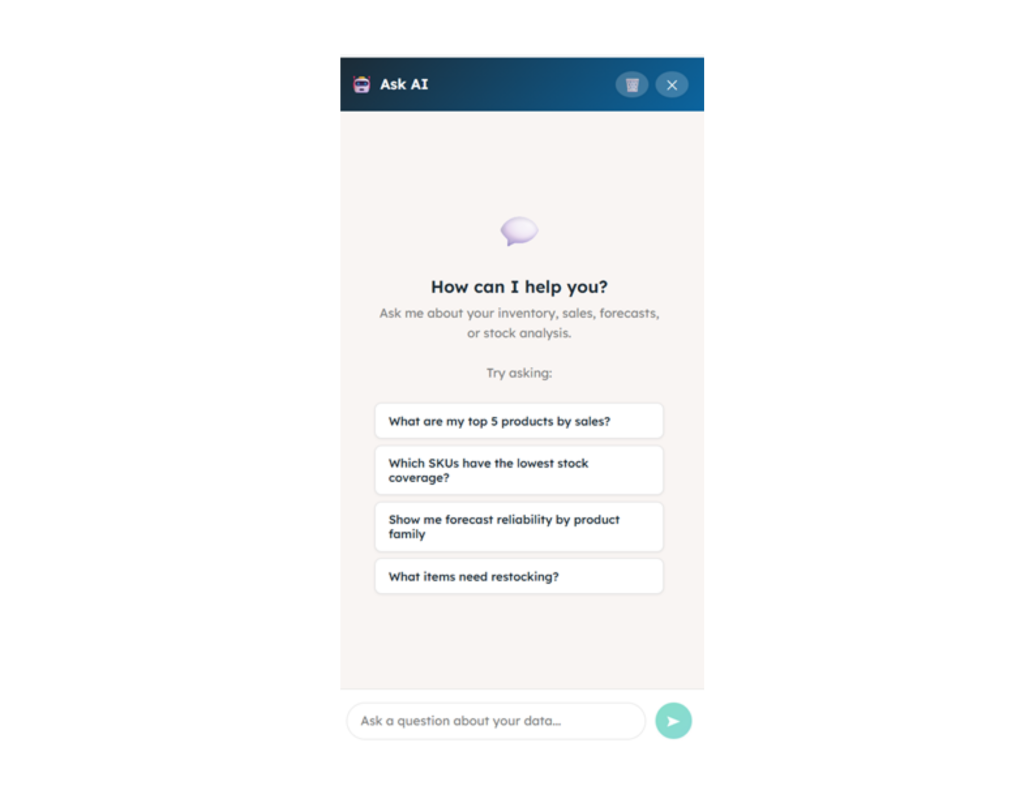
AI Chatbot for Instant Supply Chain Insights
Your built in AI assistant that explains, analyzes, and validates your supply chain data instantly – no filters, no queries, no BI complexity.
Capabilities:
- Instant Explanations of Metrics
- Natural-Language Analysis across Tabs
- Automated Data-Quality Checks
- Root-Cause Identification
- Scenario Testing
Significance:
- Surfaces issues hidden deep in BI dashboards (data errors, parameter inconsistencies).
- Helps non-experts interpret supply chain logic without training.
- Provides actionable guidance (“Which SKUs need safety stock recalibration?”).
- Ensures teams get consistent answers regardless of technical skill.
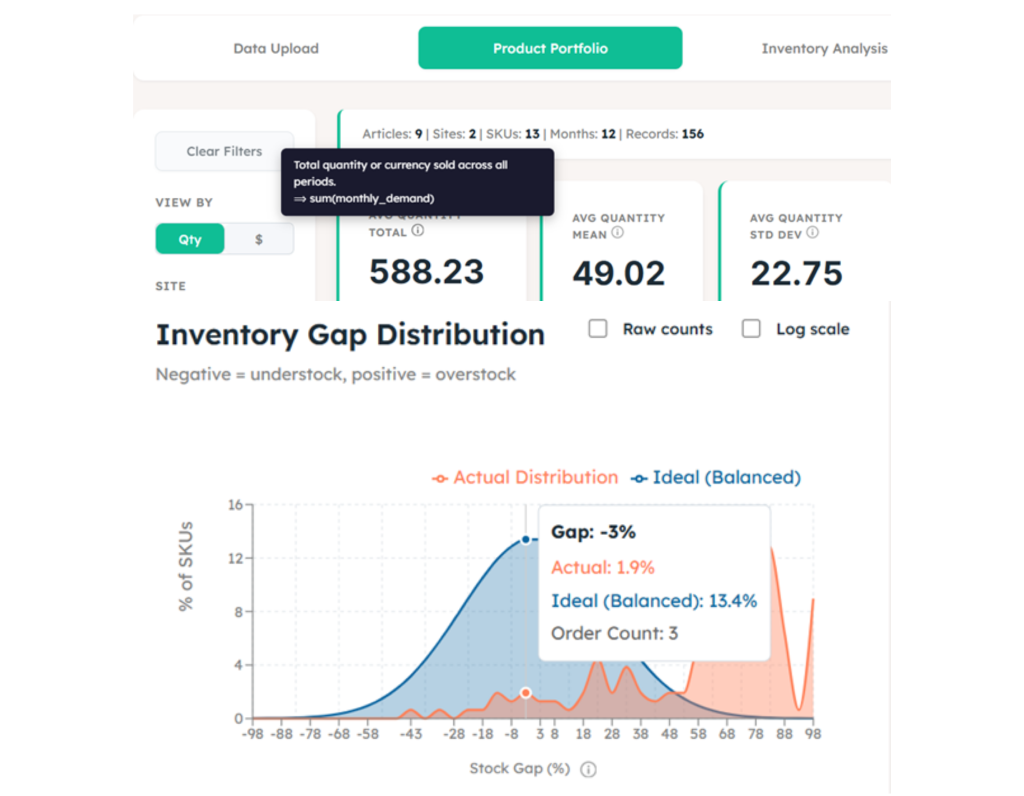
Information Points for Guidance
Purpose-built for supply chain users with intuitive filters, smart tooltips, and instant detail visibility – no BI training required.
Contextual Info (“i”) Icons Everywhere
- Every metric (coverage, stock gap, stability, etc.) has a builtin “i” definition.
- Users never guess formulas – definitions appear instantly.
- Hovering a chart or bar instantly reveals critical info such as:
- Stock Components (real, safety, rolling)
- ABC/XYZ Class
- Gap Identification
- And other values for the selected period
- Reduces onboarding time and eliminates user interpretation errors.
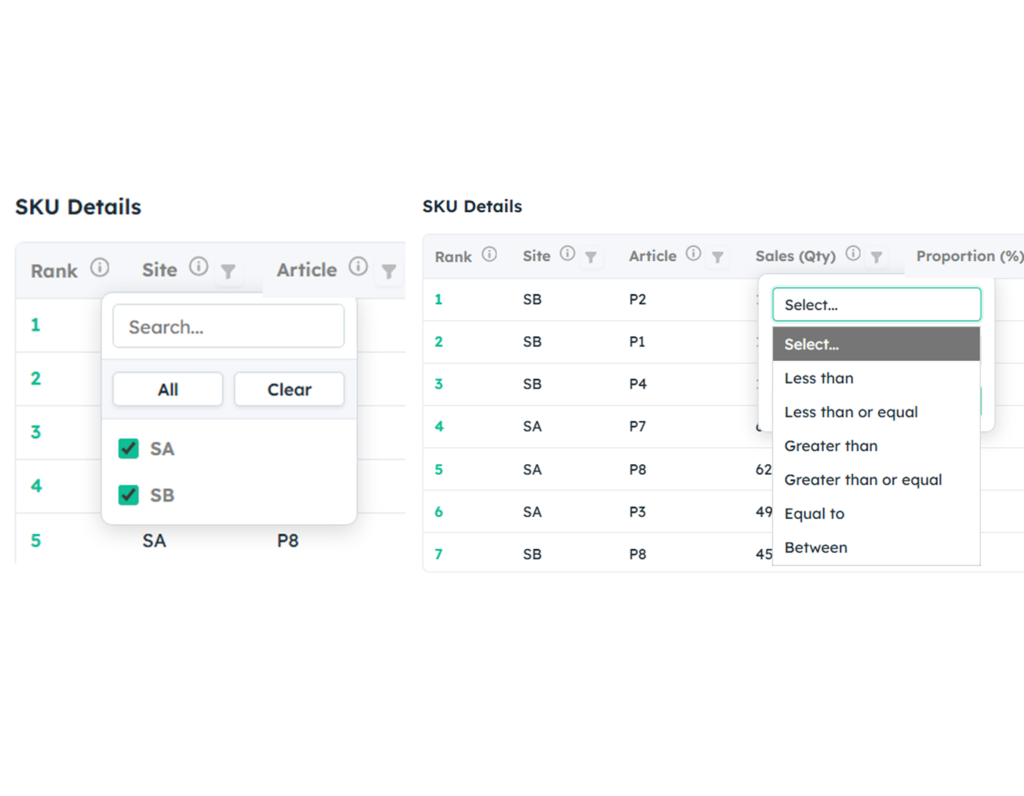
Automatic SKU Details Table
A fully synchronized, detail‑level SKU view embedded in every analysis, giving users instant access to the operational data behind each metric.
- Every view includes a fully detailed SKU table showing data embedded into each page
- Interactive filters included, such as drop down menus, and value-specific search functions (i.e. less than, greater than, etc.)
- Always synced with the filters selected above – no need to build relationships or DAX measures like in BI.


A project? Contact us
Group Managing Director and USA CEO
Laurent Penard, a founding partner of Citwell and a graduate of École Centrale, has been in the consulting industry for over 30 years. He started as a consultant with major international firms and founded Citwell in 2004. Alongside his role as the firm’s CFO, Laurent leads diagnostic assessments and supply chain transformation projects for both SMEs and large corporations in the industrial, retail, and service sectors.
In 2024, he decided to focus on expanding Citwell internationally and took on the role of President of Citwell US at the Boston office. He then passed the chairmanship of the group to Guillaume Allemand.